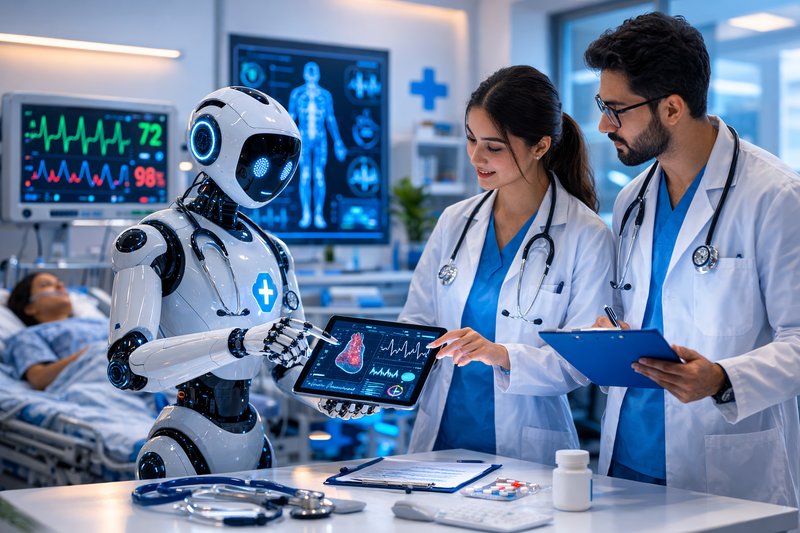
Artificial Intelligence (AI) is one of the fastest-growing fields in today?s world, and it is steadily transforming healthcare. AI refers to technologies that allow computers and machines to perform tasks that usually require human intelligence, such as learning from data, recognizing patterns, solving problems, and making decisions. In healthcare, AI is being used to improve patient care, reduce medical errors, lower costs, and make hospital systems more efficient.
Over the past few years, rapid advancements in AI technologies like machine learning, deep learning, robotics, and predictive analytics have created new opportunities in the medical field. These technologies help healthcare professionals analyse large amounts of data quickly and accurately. As a result, doctors can make better decisions, provide faster diagnoses, and develop more personalized treatment plans for patients.
AI in Diagnostics and Medical Imaging
One of the most impactful applications of AI in healthcare lies in diagnostics and medical imaging. Machine learning and deep learning algorithms are capable of analysing medical images such as X-rays, CT scans, MRIs, and ultrasounds with remarkable precision. These systems can detect abnormalities, tumours, fractures, and other conditions at early stages, sometimes identifying patterns that may be overlooked by the human eye.
AI-assisted diagnostic tools support radiologists and clinicians by providing faster and more accurate interpretations of imaging results. Early detection of diseases such as cancer, neurological disorders, and cardiovascular conditions significantly improves treatment outcomes and survival rates. By reducing diagnostic errors and saving time, AI contributes to more reliable and efficient healthcare services.
Predictive Analytics and Preventive Care
AI is increasingly being used for predictive analytics in healthcare. By analysing large volumes of patient data, including medical history, laboratory results, lifestyle information, and genetic data, AI systems can identify patterns and predict potential health risks. This enables healthcare providers to intervene early and prevent disease progression.
For example, AI models can predict the likelihood of chronic diseases such as diabetes or heart disease, allowing doctors to recommend preventive strategies. In hospital settings, predictive algorithms can identify patients at risk of complications, improving patient management and reducing healthcare costs. This shift from reactive treatment to proactive prevention marks a significant advancement in modern medicine.
Natural Language Processing and Clinical Documentation
Natural Language Processing (NLP), a branch of AI, enables computers to understand and interpret human language. In healthcare, vast amounts of information are recorded in textual form, including electronic health records (EHRs), clinical notes, discharge summaries, and research publications. NLP helps transform this unstructured data into structured, usable information.
By extracting key details such as diagnoses, medications, and lab results from medical records, NLP improves clinical documentation and decision-making. It also powers virtual assistants and healthcare chatbots that answer patient queries, provide health information, and assist with appointment scheduling. These applications enhance accessibility while reducing administrative burdens on healthcare professionals.
Robotics in Surgery and Patient Care
Robotics, integrated with AI technologies, is another rapidly growing sector in healthcare. Robotic surgical systems enable surgeons to perform minimally invasive procedures with enhanced precision and control. These systems provide improved visualization, greater dexterity, and reduced invasiveness, resulting in shorter hospital stays and faster recovery times for patients.
Beyond surgery, robotic systems assist in patient care and rehabilitation. Robots can help lift and transfer patients, reducing physical strain on healthcare workers. Robotic exoskeletons support patients recovering from injuries or neurological disorders by aiding mobility and strengthening rehabilitation outcomes. In addition, AI-enabled robots facilitate telemedicine and remote monitoring, allowing healthcare providers to deliver care in real time, even in remote or underserved areas.
AI in Drug Discovery and Research
Drug development is traditionally a time-consuming and expensive process. AI is accelerating this process by analysing complex biological and chemical data to identify potential drug candidates more efficiently. AI algorithms can predict how different compounds will interact with biological systems, reducing the need for extensive trial-and-error experimentation.
In medical research, AI helps analyse large datasets, identify trends, and generate new insights. By processing vast volumes of scientific literature and clinical trial data, AI supports researchers in discovering innovative treatments and improving therapeutic strategies. This has the potential to significantly reduce the time required to bring new medicines to market.
Administrative Efficiency and Healthcare Management
AI is not limited to clinical applications; it also enhances healthcare administration. Hospitals and healthcare institutions use AI systems to manage scheduling, optimize resource allocation, streamline billing processes, and reduce operational inefficiencies. Automated systems can handle repetitive tasks, allowing healthcare professionals to focus more on patient-centred care.
Additionally, AI-powered systems assist in inventory management, medication tracking, and workflow optimization. These improvements reduce errors, lower operational costs, and enhance overall system performance.
Ethical Challenges and Future Possibilities
Despite its many advantages, the integration of AI into healthcare presents several challenges. Data privacy and security remain major concerns, as AI systems rely heavily on sensitive patient information. Ensuring ethical use, transparency, and fairness in AI algorithms is essential to prevent bias and discrimination.
There are also concerns regarding reliability and accountability. AI systems must undergo rigorous validation and regulatory oversight to ensure patient safety. Importantly, while AI can enhance healthcare delivery, it cannot replace the empathy, judgment, and ethical responsibility of healthcare professionals.
Looking ahead, the future of AI in healthcare appears promising. As technologies continue to evolve, AI is expected to further support personalized medicine, improve global health accessibility, and enable more precise and data-driven treatment strategies. Collaboration between technologists, healthcare providers, and policymakers will be essential to ensure that AI is implemented responsibly and equitably.
Conclusion
Artificial Intelligence is reshaping the healthcare landscape by improving diagnostics, enabling predictive care, enhancing surgical precision, accelerating research, and optimizing healthcare management. While challenges related to ethics, privacy, and reliability remain, the benefits of AI in healthcare are substantial. Rather than replacing medical professionals, AI serves as a powerful tool that strengthens their ability to deliver effective, efficient, and patient-centred care. As innovation continues, AI is set to play an increasingly vital role in shaping the future of global healthcare systems.
References
1. Ramalingam, A., A. Karunamurthy, and B. Pavithra. 2023. ?Impact of Artificial Intelligence on Healthcare: A Review of Current Applications and Future Possibilities.? Quing International Journal of Innovative Research in Science and Engineering 2 (2): 37?49. https://doi.org/10.54368/qijirse.2.2.0005
2. Topol, E. (2019). High-performance medicine: The convergence of human and artificial intelligence. Nature Medicine, 25(1), 44?56. https://doi.org/10.1038/s41591-018-0300-7
3. Jiang, F., Jiang, Y., Zhi, H., Dong, Y., Li, H., Ma, S., Wang, Y., Dong, Q., Shen, H., & Wang, Y. (2017). Artificial intelligence in healthcare: Past, present and future. Stroke and Vascular Neurology, 2(4), 230?243. https://doi.org/10.1136/svn-2017-000101
4. Esteva, A., Kuprel, B., Novoa, R. A., Ko, J., Swetter, S. M., Blau, H. M., & Thrun, S. (2017). Dermatologist-level classification of skin cancer with deep neural networks. Nature, 542(7639), 115?118. https://doi.org/10.1038/nature21056
5. Rajkomar, A., Dean, J., & Kohane, I. (2019). Machine learning in medicine. The New England Journal of Medicine, 380(14), 1347?1358. https://doi.org/10.1056/NEJMra1814259
6. Davenport, T., & Kalakota, R. (2019). The potential for artificial intelligence in healthcare. Future Healthcare Journal, 6(2), 94?98. https://doi.org/10.7861/futurehosp.6-2-94