Abstract
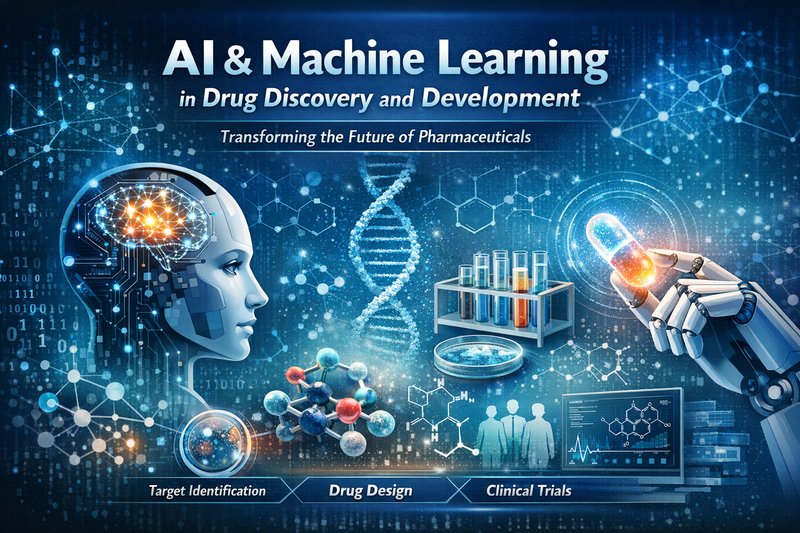
The growing complexity of drug discovery, coupled with rising development costs and declining success rates, has created an urgent need for innovative approaches within the pharmaceutical industry. Artificial intelligence (AI) and machine learning (ML) have emerged as transformative technologies capable of reshaping how drugs are discovered, developed, and evaluated. Rather than serving as mere automation tools, AI-driven systems are increasingly influencing strategic decision-making across the drug development pipeline. This article discusses how AI and ML are actively redefining target selection, molecular design, and clinical trial execution, while also examining the ethical and regulatory implications of their expanding role. The integration of intelligent systems into pharmaceutical research represents a fundamental shift toward data-driven, adaptive, and patient-centric drug development.
Keywords: Artificial intelligence, machine learning, pharmaceutical innovation, drug development, clinical research, ethics
Introduction
Drug discovery has traditionally relied on incremental experimentation, expert intuition, and prolonged trial-and-error processes. While these methods have delivered life-saving therapies, they are increasingly insufficient in the face of complex diseases such as cancer, neurodegenerative disorders, and rare genetic conditions. The accumulation of vast biological and clinical datasets has outpaced the ability of conventional analytical tools to extract meaningful insights.
Artificial intelligence and machine learning provide an opportunity to bridge this gap. By learning from large, heterogeneous datasets, AI systems can recognize patterns that may not be apparent through human analysis alone. In recent years, pharmaceutical organizations have begun to reposition AI not as an auxiliary technology, but as a strategic driver of innovation. This shift marks a turning point in how therapeutic discovery and development are conceptualized.
AI-Driven Target Identification: Moving Beyond Hypothesis-Led Discovery
The identification of biologically relevant drug targets is a decisive step that often determines downstream success or failure. Traditional target discovery is typically hypothesis-driven, relying on known disease mechanisms and experimental validation. While effective, this approach may overlook complex, multi-factorial interactions underlying disease progression.
AI and ML approaches enable a data-first paradigm, integrating genomic, proteomic, transcriptomic, and clinical datasets to uncover novel disease-associated targets. By analyzing network interactions and biological pathways, ML models can prioritize targets based on predicted therapeutic relevance rather than isolated biological signals. This shift reduces dependency on single-gene hypotheses and allows a more holistic understanding of disease biology.
Importantly, AI-driven target identification also facilitates drug repurposing by revealing unexpected connections between existing drugs and new disease indications, thereby shortening development timelines and reducing costs.
Intelligent Drug Design and Optimization
Following target selection, the discovery and optimization of lead compounds present significant challenges related to efficiency and attrition. Conventional medicinal chemistry approaches, although powerful, are limited by experimental throughput and chemical space exploration.
AI-based molecular design tools are redefining this stage by enabling predictive modeling of compound behavior before synthesis. Machine learning algorithms can assess molecular properties such as potency, toxicity, and pharmacokinetic profiles, allowing researchers to prioritize candidates with higher probabilities of success. Generative models further enhance innovation by designing novel chemical structures optimized for specific therapeutic goals.
This intelligent design approach does not replace human expertise but augments it, allowing scientists to make informed decisions based on computational insights rather than exhaustive experimental screening.
Reinventing Clinical Trials Through AI
Clinical development remains the most resource-intensive phase of drug development and a major contributor to late-stage failure. Poor patient selection, suboptimal trial design, and insufficient real-time monitoring often compromise trial outcomes.
AI offers practical solutions by enabling data-driven trial optimization. Predictive models can assist in selecting appropriate patient populations, identifying biomarkers of response, and optimizing dosing strategies. Additionally, AI-powered digital tools facilitate remote monitoring and real-time data analysis, improving patient adherence and safety oversight.
The application of machine learning to adaptive trial designs allows dynamic decision-making during trials, potentially reducing duration, cost, and failure rates. This represents a shift from static trial protocols to flexible, learning-based clinical research models.
Ethical, Regulatory, and Societal Considerations
The increasing reliance on AI in drug development raises important ethical and regulatory questions. Data integrity, algorithmic bias, and transparency are critical concerns, particularly when AI-driven decisions influence patient safety and regulatory approval.
Regulatory frameworks have yet to fully adapt to AI-enabled drug development. The use of opaque ?black-box? algorithms challenges traditional expectations of scientific explainability. To address this, there is a growing emphasis on explainable AI models and standardized validation processes.
Ethical implementation also requires safeguarding patient data privacy and ensuring equitable representation in training datasets. Without careful governance, AI systems risk reinforcing existing healthcare disparities rather than alleviating them.
Future Outlook
As AI technologies continue to evolve, their integration into pharmaceutical research is expected to deepen. The future lies in hybrid models that combine AI-driven insights with experimental validation and clinical expertise. Collaboration between technologists, scientists, regulators, and ethicists will be essential to ensure responsible innovation.
In the long term, AI has the potential to shift drug development from a reactive process to a predictive and preventative one, enabling earlier interventions and more personalized therapies.
Conclusion
Artificial intelligence and machine learning are no longer experimental concepts within pharmaceutical research; they are active agents of transformation. By reshaping target identification, drug design, and clinical development, AI is enabling a more efficient and adaptive drug discovery ecosystem. However, technological progress must be matched with ethical responsibility and regulatory evolution. When implemented thoughtfully, AI-driven drug development holds the promise of accelerating therapeutic innovation while improving patient outcomes.
References
- Paul, D., Sanap, G., Shenoy, S., Kalyane, D., Kalia, K., & Tekade, R. K. (2021). Artificial intelligence in drug discovery and development. Drug Discovery Today, 26(1), 80?93.
- Vamathevan, J., Clark, D., Czodrowski, P., et al. (2019). Applications of machine learning in drug discovery and development. Nature Reviews Drug Discovery, 18(6), 463?477.
- Mak, K. K., & Pichika, M. R. (2019). Artificial intelligence in drug development: Present status and future prospects. Drug Discovery Today, 24(3), 773?780.
- Chen, H., Engkvist, O., Wang, Y., Olivecrona, M., & Blaschke, T. (2018). The rise of deep learning in drug discovery. Drug Discovery Today, 23(6), 1241?1250.
- Schneider, G. (2020). Automating drug discovery. Nature Reviews Drug Discovery, 19(6), 353?354.
- Zhavoronkov, A., Ivanenkov, Y. A., Aliper, A., et al. (2019). Deep learning enables rapid identification of potent DDR1 kinase inhibitors. Nature Biotechnology, 37(9), 1038?1040.
- Topol, E. J. (2019). High-performance medicine: the convergence of human and artificial intelligence. Nature Medicine, 25(1), 44?56.
- Harrer, S., Shah, P., Antony, B., & Hu, J. (2019). Artificial intelligence for clinical trial design. Trends in Pharmacological Sciences, 40(8), 577?591.
- U.S. Food and Drug Administration (FDA). (2023). Artificial Intelligence and Machine Learning in Drug Development: Discussion Paper. FDA, Center for Drug Evaluation and Research.
- European Medicines Agency (EMA). (2023). Reflection paper on the use of artificial intelligence in the medicinal product lifecycle. EMA.
- Rudin, C. (2019). Stop explaining black box machine learning models for high stakes decisions and use interpretable models instead. Nature Machine Intelligence, 1, 206?215.
- Mesko, B., Gyorffy, Z., & Koll?r, J. (2020). Digital health is a cultural transformation of traditional healthcare. mHealth, 6, 38.