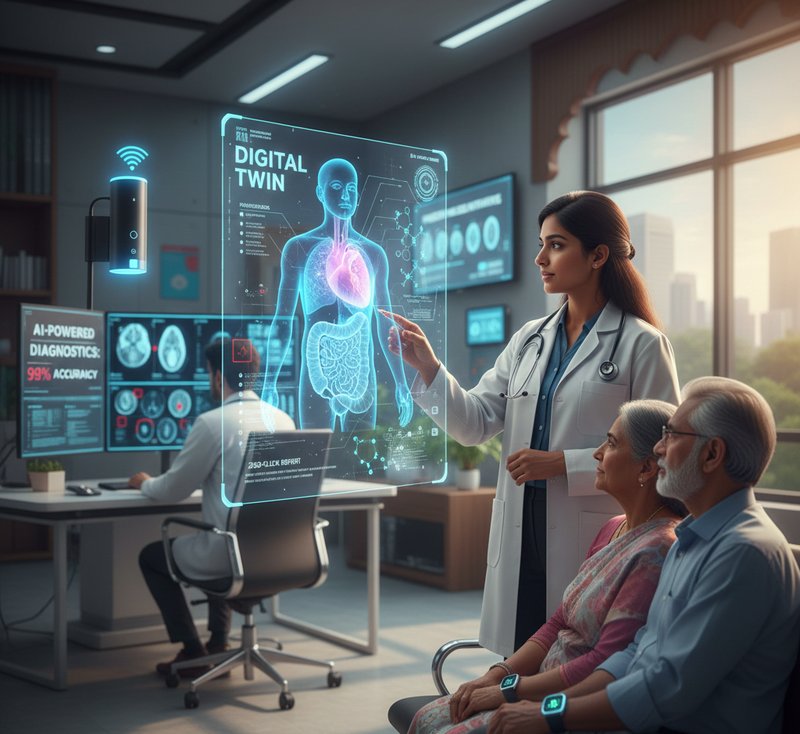
Healthcare in India faces immense challenges. With a population exceeding 1.4 billion, rising prevalence of chronic diseases, and a limited number of healthcare professionals, the system often struggles to meet patient needs. According to the National Health Profile 2022, India has only 1.9 doctors per 1,000 population, far below the WHO-recommended standard of 4.5 per 1,000. This shortage creates delays in diagnosis and treatment, especially in rural areas, where access to specialists is scarce.
Artificial Intelligence (AI) is emerging as a transformative solution. By analyzing large volumes of data and identifying patterns, AI is helping healthcare professionals diagnose diseases faster, predict patient risks, optimize hospital operations, and educate the public. No longer a futuristic concept, AI is becoming a tangible force in Indian healthcare, offering hope for a system that is smarter, faster, and more accessible.
This article explores AI?s role in disease detection, predictive healthcare, hospital management, telemedicine, public health, and the ethical and operational challenges of adoption. Real-life Indian examples highlight how AI is already making a difference, and initiatives like CHEARS are preparing the next generation of healthcare innovators to integrate technology responsibly.
AI in Disease Detection and Diagnosis
Early Detection Saves Lives
Early detection of diseases significantly improves survival rates. AI-powered diagnostic systems are capable of analyzing medical images such as X-rays, CT scans, MRIs, and ultrasounds with remarkable precision. Machine learning algorithms learn to identify subtle anomalies that may be difficult for human eyes to detect. For instance, AI can detect early signs of diabetic retinopathy, a leading cause of preventable blindness, long before symptoms become noticeable.
In oncology, AI has shown impressive results. Breast, lung, and cervical cancers, which account for a large portion of cancer-related deaths in India, can be detected earlier using AI models trained on thousands of imaging datasets. Early detection increases the chances of successful treatment and reduces the burden on tertiary care centers.
Case Studies: Hospitals Leading the Way
Several Indian hospitals are adopting AI in diagnostic processes:
Apollo Hospitals: AI algorithms analyze CT scans and X-rays to prioritize urgent cases, reducing diagnostic turnaround time by up to 40%. During the COVID-19 pandemic, AI-assisted chest X-ray analysis helped radiologists quickly identify pneumonia-like lung involvement.
Narayana Health: AI is integrated into cardiology departments to detect early signs of heart disease. Machine learning models assess echocardiogram results and highlight high-risk patients for immediate intervention.
Reaching Rural Areas
India?s rural population often lacks access to specialists. AI-powered tele-diagnostic tools allow mobile clinics to capture medical images locally and transmit them for analysis. For example, thermal imaging devices powered by AI can detect early-stage breast cancer in women living in remote villages. These innovations ensure early detection, reducing travel burdens and improving survival outcomes.
Predictive Healthcare and Preventive Care
Shifting From Treatment to Prevention
Predictive healthcare is one of AI?s most promising applications. By analyzing patient data, wearable devices, and medical histories, AI can identify individuals at risk of developing chronic diseases. For example, algorithms can predict the likelihood of diabetes or cardiovascular complications based on lifestyle habits, family history, and biometrics.
Preventive recommendations, such as dietary modifications, exercise routines, or early screenings, allow doctors to intervene before the disease progresses. This not only improves patient outcomes but also reduces long-term healthcare costs.
AI-Enabled Wearables
Wearables, including smartwatches and fitness trackers, continuously monitor vital signs such as heart rate, oxygen levels, sleep patterns, and activity levels. AI algorithms process this data to identify deviations from normal patterns. For instance, irregular heart rhythms or oxygen fluctuations can trigger alerts to both the patient and their physician, enabling timely intervention.
Companies like HealthifyMe have integrated AI into their apps to provide real-time health insights, helping individuals understand their risks and make informed lifestyle choices.
Public Health Applications
AI also has a macro-level impact on public health. During the COVID-19 pandemic, AI models were used to predict outbreak hotspots, optimize hospital resources, and manage vaccine distribution in India. By analyzing population movement, testing data, and hospital admissions, AI provided actionable insights that helped healthcare authorities make timely decisions.
Enhancing Hospital Operations
Administrative Efficiency
AI improves hospital efficiency by automating repetitive administrative tasks. Appointment scheduling, billing, patient triage, and record management can now be managed by AI systems, freeing staff to focus on clinical care. This streamlining improves patient satisfaction and reduces errors caused by manual processing.
Virtual Assistants and Chatbots
AI-powered chatbots and virtual assistants play an increasingly important role in patient engagement. Platforms like Mfine provide accurate health information, answer questions, and guide patients through care pathways. Chatbots can triage patients by asking a series of symptom-based questions and suggesting appropriate action, ensuring timely care while reducing the burden on healthcare staff.
Resource Planning and Optimization
AI predicts patient inflow, monitors hospital bed occupancy, and manages inventory for medications and medical equipment. During peak periods or emergencies, hospitals can allocate staff and resources efficiently, improving patient care and operational sustainability.
AI and Telemedicine
Expanding Access to Healthcare
Telemedicine has grown exponentially in India, and AI has amplified its impact. AI-driven systems analyze symptoms and medical histories to provide preliminary guidance. Patients in rural or underserved areas can access specialist advice without traveling long distances, saving time and resources.
Remote Patient Monitoring
Chronic disease management benefits greatly from AI-enabled remote monitoring. Devices continuously track vital signs and alert physicians if abnormalities arise. For example, cardiac patients monitored through AI platforms receive immediate alerts in case of irregular heartbeats, enabling prompt intervention.
Bridging Urban-Rural Gaps
AI-powered telemedicine reduces disparities between urban and rural healthcare. Patients in remote regions can access consultations, diagnostics, and educational resources, leveling the healthcare playing field.
Real-Life AI Innovations in India
Several initiatives demonstrate the transformative potential of AI:
Niramai Health Analytix: Uses thermal imaging and AI algorithms to detect early-stage breast cancer, offering a non-invasive and affordable solution.
AIIMS & Microsoft Collaboration: Predictive AI models identify sepsis in hospitalized patients, enabling timely interventions.
Apollo Hospitals ? COVID-19 Response: AI models forecasted patient surges and optimized ICU bed allocation and oxygen supply management.
Tata Memorial Centre: Using AI algorithms to detect and monitor cancer progression, improving treatment outcomes and reducing manual workload for oncologists.
These examples highlight that AI is not just theoretical,it is already improving healthcare outcomes across India.
Challenges in AI Adoption
Despite its potential, AI adoption faces several hurdles:
Data Privacy: Patient data is sensitive, and AI systems require large datasets. The Digital Personal Data Protection Act, 2023, provides regulatory guidance, but implementation is uneven.
Infrastructure Limitations: Many hospitals still rely on paper-based records. Integrating AI requires digitization and significant investment in technology and training.
Skilled Workforce: Healthcare professionals must be trained to use AI effectively. Initiatives like CHEARS provide hands-on training and workshops for students and professionals.
Ethical Concerns: Algorithmic bias and lack of transparency can compromise fairness. Ethical AI practices are essential to ensure equitable patient care.
The Future of AI in Indian Healthcare
AI promises a future of personalized, precise, and patient-centered care.
Personalized Medicine: AI can combine genetic, lifestyle, and clinical data to create individualized treatment plans.
Robotics-Assisted Surgery: AI-guided robotic surgery enhances precision, reduces recovery times, and minimizes complications.
Global Collaborations: Partnerships with international institutions bring cutting-edge AI technologies to India, helping local hospitals improve patient care.
Public awareness and education are crucial. CHEARS and similar initiatives empower healthcare students and professionals with the knowledge and skills to apply AI responsibly.
Conclusion
Artificial Intelligence is transforming healthcare in India. From diagnostics and preventive care to hospital management and telemedicine, AI is improving efficiency, accessibility, and patient outcomes. By combining technological innovation with ethical practices, workforce training, and public awareness, India can build a healthcare system that is intelligent, inclusive, and patient-centered. The future of healthcare in India is not only digital, it is smarter, faster, and designed to meet the needs of millions of patients more effectively than ever before.
References
Rajkomar, A., Dean, J., & Kohane, I. (2019). Machine Learning in Medicine. New England Journal of Medicine, 380, 1347?1358.
Ministry of Health and Family Welfare, Government of India. (2022). National Digital Health Mission.
Topol, E. (2019). Deep Medicine: How Artificial Intelligence Can Make Healthcare Human Again. Basic Books.
Nguyen, N. T., et al. (2021). AI for Chronic Disease Prediction in India: Opportunities and Challenges. Journal of Healthcare Informatics Research, 5, 1?16.
CHEARS. (2025). Innovating Healthcare through Technology in India. CHEARS Official Website.
Niramai Health Analytix. (2023). AI-based Breast Cancer Screening in India.
Apollo Hospitals. (2020). AI Models for COVID-19 Patient Care Management.
AIIMS & Microsoft Collaboration. (2021). Predictive Models for Sepsis Detection.