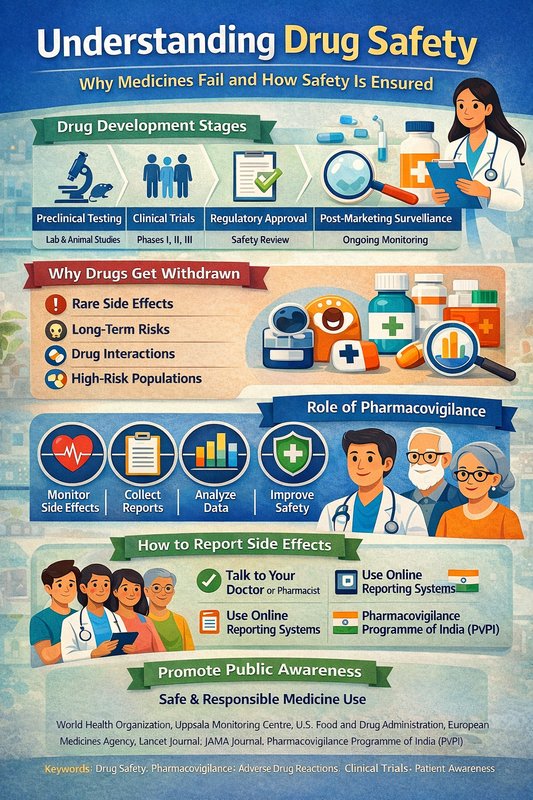
Understanding Drug Safety: Why Medicines Fail and How Safety Is Ensured
Abstract
Medicines play a critical role in improving health and saving lives; however, not all drugs remain safe throughout their lifecycle. Many people assume that once a medicine is approved, it is completely risk-free. In reality, drug safety is a continuous process that extends far beyond laboratory testing and regulatory approval. This article explains the stages of drug development in simple terms, explores why some medicines are withdrawn from the market, highlights the role of pharmacovigilance, and explains how patients and healthcare professionals can report adverse drug reactions. Improving public understanding of drug safety is essential for responsible medicine use and patient protection.
Keywords: Drug safety, pharmacovigilance, adverse drug reactions, clinical trials, patient awareness
Introduction
Medicines are among the most powerful tools in modern healthcare, yet no drug is entirely free from risk. Every medicine carries the potential for side effects, interactions, or unexpected outcomes. Drug safety is therefore a fundamental component of pharmaceutical science and public health. Despite strict regulatory controls, some medicines fail after approval due to safety concerns that only become evident during widespread use.
Understanding how drug safety is ensured helps patients make informed decisions and encourages responsible use of medicines. This article aims to simplify complex regulatory and scientific concepts related to drug safety and make them accessible to the general public and students.
Drug Development Stages Explained Simply
Before a medicine reaches patients, it undergoes several carefully monitored stages designed to assess its safety and effectiveness.
Preclinical Testing
At this stage, the drug is tested in laboratories and on animals to evaluate basic safety, toxicity, and biological activity. Only compounds showing acceptable safety profiles move forward.
Clinical Trials
Clinical trials are conducted in human volunteers and are divided into phases:
- Phase I: Tests safety and dosage in a small group of healthy volunteers
- Phase II: Evaluates effectiveness and side effects in patients
- Phase III: Confirms safety and efficacy in large populations
If a drug successfully completes these phases, regulatory authorities may grant approval.
Post-Marketing Surveillance
Even after approval, safety monitoring continues. This phase is critical because rare or long-term side effects may only appear when the drug is used by a large and diverse population.
Why Some Medicines Are Withdrawn
Drug withdrawal does not always mean that a medicine was poorly developed. Some safety risks are impossible to detect during clinical trials due to limited sample sizes or short study durations.
Common reasons for drug withdrawal include:
- Rare but serious adverse reactions
- Long-term toxicity
- Drug interactions not previously identified
- Increased risk in specific populations
Historical examples have shown that post-marketing data can reveal safety issues that were not evident during trials. Regulatory agencies act to protect public health by restricting use, updating warnings, or withdrawing drugs when necessary.
Role of Pharmacovigilance in Drug Safety
Pharmacovigilance is the science of monitoring, detecting, assessing, and preventing adverse effects of medicines after they are marketed. It plays a vital role in ensuring that the benefits of a drug continue to outweigh its risks.
Pharmacovigilance systems collect safety data from:
- Healthcare professionals
- Hospitals and clinics
- Patients and caregivers
- Pharmaceutical companies
This information helps regulators update drug labels, issue safety alerts, and make informed decisions about continued drug use.
How Patients Can Report Side Effects
Patients play a crucial role in drug safety. Reporting side effects helps identify potential risks early and improves overall medicine safety.
Patients can report adverse drug reactions by:
- Informing their doctor or pharmacist
- Submitting reports through national pharmacovigilance programs
- Using online reporting portals or mobile applications
In India, adverse reactions can be reported through the Pharmacovigilance Programme of India (PvPI). Similar systems exist worldwide, encouraging patient participation in safety monitoring.
Importance of Public Awareness in Drug Safety
Educating the public about drug safety promotes responsible medicine use and reduces harm caused by misuse, self-medication, or ignoring side effects. Awareness empowers patients to ask questions, follow prescriptions correctly, and report unusual reactions promptly.
Healthcare professionals, regulators, and patients must work together to ensure that medicines remain safe throughout their lifecycle.
Conclusion
Drug safety is not a one-time evaluation but a continuous process that extends from drug discovery to real-world use. While regulatory systems are designed to protect patients, active participation from healthcare professionals and the public is essential. By understanding how medicines are tested, monitored, and regulated, individuals can contribute to safer healthcare outcomes and improved public trust in medicines.
References
- World Health Organization. (2002). The Importance of Pharmacovigilance: Safety Monitoring of Medicinal Products. WHO Press.
- Uppsala Monitoring Centre. (2020). Pharmacovigilance: Ensuring the Safe Use of Medicines. WHO Collaborating Centre.
- U.S. Food and Drug Administration (FDA). (2023). The Drug Development Process. FDA.
- European Medicines Agency (EMA). (2022). Pharmacovigilance and Adverse Drug Reaction Reporting. EMA.
- Edwards, I. R., & Aronson, J. K. (2000). Adverse drug reactions: Definitions, diagnosis, and management. The Lancet, 356(9237), 1255?1259.
- Lazarou, J., Pomeranz, B. H., & Corey, P. N. (1998). Incidence of adverse drug reactions in hospitalized patients. Journal of the American Medical Association, 279(15), 1200?1205.
- Pharmacovigilance Programme of India (PvPI). (2023). Guidance on Adverse Drug Reaction Reporting. Indian Pharmacopoeia Commission.