
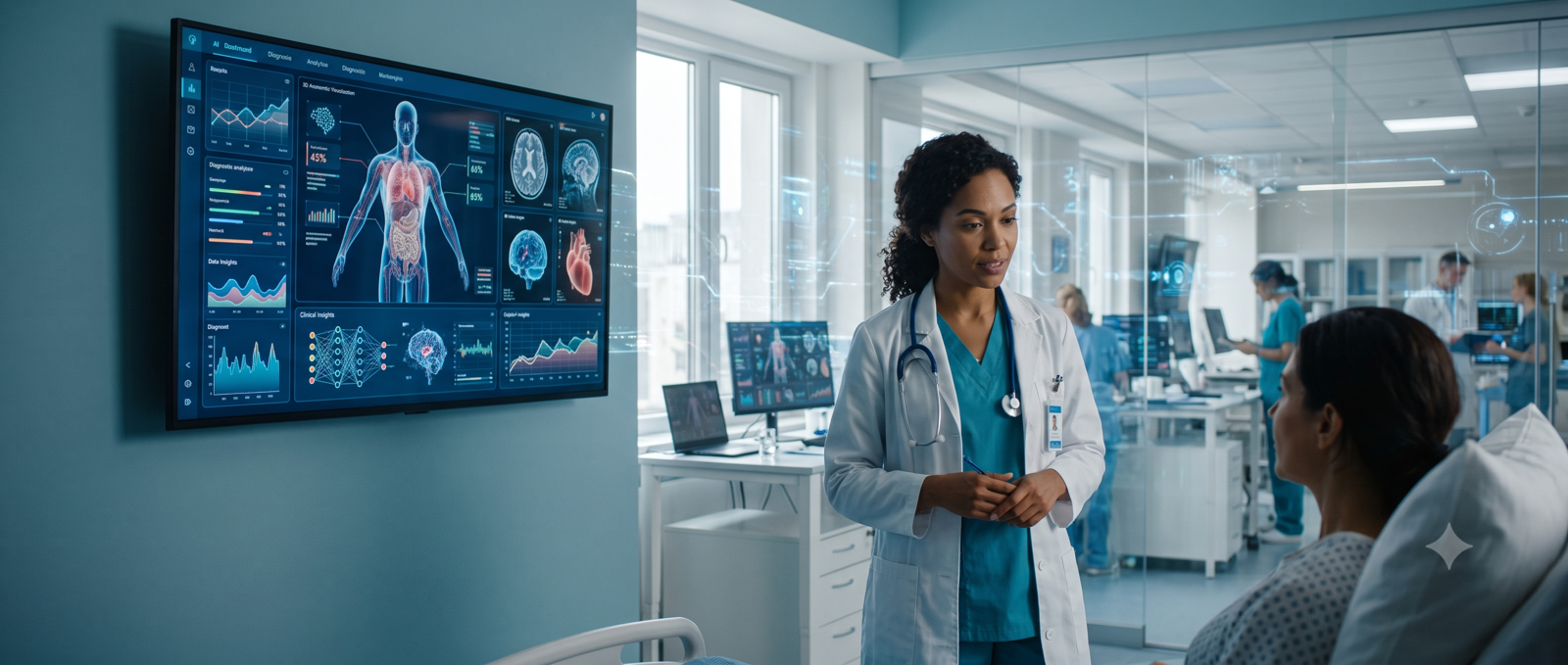
Healthcare systems face high costs, staffing shortages, and complex disease management. Fortunately, the push to digitise healthcare is generating massive amounts of data from EHRs, gene sequencing, and medical scans. AI helps manage this data, with the global healthcare AI market projected to jump from roughly $20.9 to $26.6 billion in 2024 to over $148 to $187 billion by 2029-2030. Going after these advances could save hospitals $150 billion to $360 billion a year by cutting treatment errors and streamlining operations.
1. Clinical Applications and Enhanced Diagnostics
Doctors are using computer vision, Convolutional Neural Networks (CNNs), and tree-based algorithms to change how they treat patients in lots of different specialities.
Medical Imaging and Diagnostics
AI works well in fields that spot patterns, like reading scans or looking at skin. Modern imaging algorithms hit diagnostic accuracy above 90%, often matching or beating human specialists.
- Radiology: Artificial intelligence swiftly examines chest X-rays, CT scans, and MRIs to prioritise urgent issues such as brain bleeds and acute pulmonary embolisms, significantly reducing the time until treatment begins.
- Pathology: Deep learning models identify subtle tumour margins in lymph node biopsies that manual microscopic evaluation might otherwise miss.
- Ophthalmology: Point-of-care autonomous screening tools for diabetic eye disease achieve remarkable accuracy. Bringing these tools to community clinics boosted screening compliance for at-risk groups from 49% to 95%, which lessened health outcome gaps.
Clinical Decision Support Systems (CDSS)
Moving past static images, machine learning algorithms serve as real-time engines integrated into EHR systems to monitor patient vital signs and laboratory data
- Sepsis Prediction: The system spots small body changes hours before septic shock hits, giving ICU teams a critical window to start fluids and antibiotics.
- Oncology & Cardiology: Algorithms look at genomic sequencing and clinical data to design very specific chemo combos. Likewise, tree-based models beat static equations for calculating acute cardiovascular risks.
2. Streamlining Operational and Administrative Workflows
Diagnostic tools get the hype, but AI's biggest impact right now is streamlining back-end healthcare logistics and admin work.
Alleviating Clinician Burnout
Burnout among physicians and nurses is strongly linked to the heavy documentation demands of current medical record systems. Ambient intelligent systems use Generative Large Language Models and acoustic listening tech to change patient-doctor talks. These systems capture conversations safely and turn unstructured talks into organised clinical notes, discharge summaries, and pre-authorisation requests instantly, greatly freeing up face-to-face patient time.
Hospital Operations and Resource Management
Hospitals use predictive operational analytics to keep patients safe and help plan staffing levels. Neural networks assess regional health data, past statistics, and weather predictions to forecast emergency department spikes, enabling administrators to adjust bed availability. At the same time, background algorithms examine active charts to prevent medication mistakes, identify hazardous drug interactions, and mark patients who are high risk for hospital-acquired infections or accidental falls.
3. Implementation Barriers: Technical, Ethical, and Legal
Even with strong clinical proof, moving AI from small trials to wide medical use faces major technical, regulatory, and social barriers.
The "Black-Box" and Interface Gaps
AI models need large amounts of consistent data, but the global healthcare IT sector stays split due to proprietary, isolated software platforms. Additionally, deep neural networks operate with " black-box " transparency, as their mathematical reasoning pathways are too complex for a human clinician to audit. The unexplained nature of this issue naturally causes clinical scepticism when making high-stakes treatment decisions.
Algorithmic Bias and Data Privacy
Models trained on clinical data from top urban hospitals often show bias when used in rural or under-resourced areas. These flawed risk calculations risk widening current health disparities. Moreover, compiling large patient datasets creates significant risks to data privacy, necessitating robust encryption to protect sensitive health details from cyber threats.
Legal Malpractice and Liability
Automated healthcare software operates within medical liability frameworks that are poorly adapted to it. If a self-operating diagnostic algorithm overlooks a crucial finding on a scan, determining legal responsibility remains unclear. It remains unclear whether responsibility lies with the treating physician, the hospital network responsible for procurement, or the commercial software vendor. The lack of worldwide legal uniformity is keeping broad market uptake moving slowly.
4. The Horizon of Healthcare Delivery
Over the coming ten years, AI will move from separate, task-specific tools to fully unified healthcare networks. One key factor behind this change is federated learning, which enables different healthcare organisations to jointly train machine learning models while keeping private patient data within local networks.
AI systems are not meant to take the place of human clinicians altogether. True medical progress depends on working together with computers. By assigning heavy paperwork and automated screenings to AI, healthcare workers can reduce administrative burdens and refocus on compassionate direct patient care.